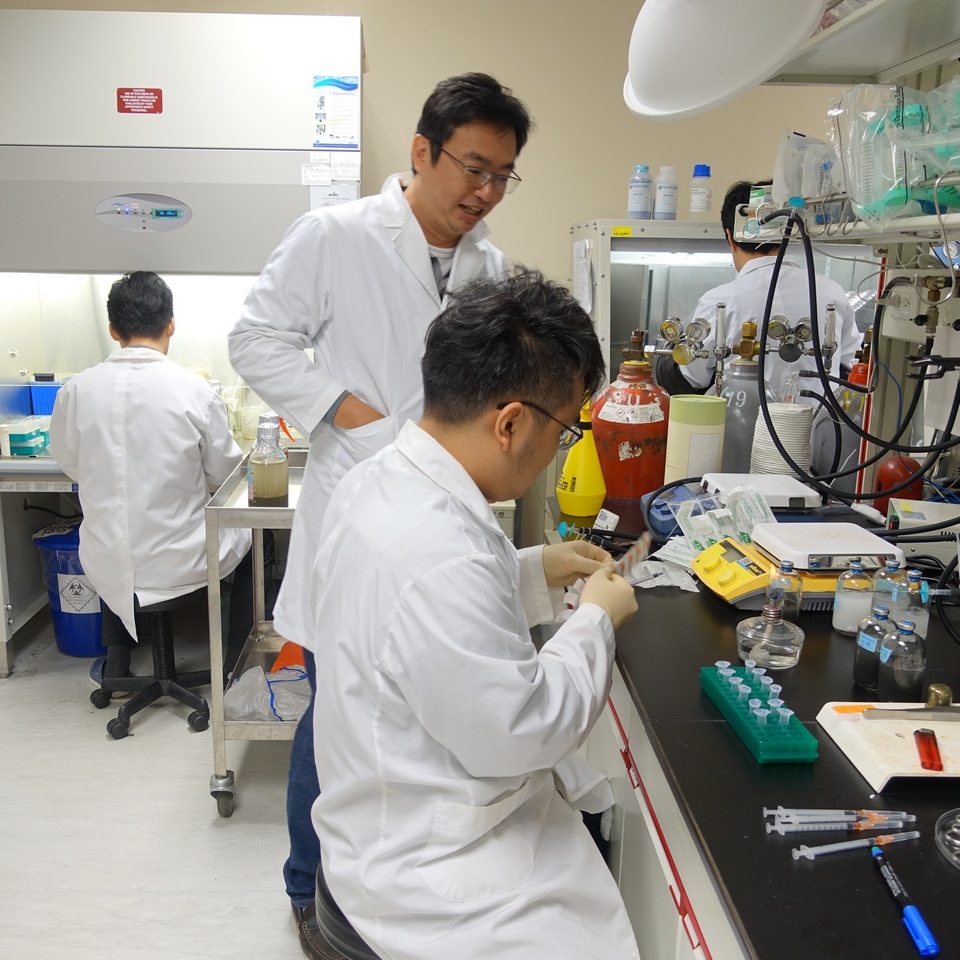




Gut Bacteria Become Micro-Pharmaceutical Factories: Precise Neurosteroid Synthesis Achieved Using Plant Waste
The human gut is home to trillions of microorganisms, and recent research continues to reveal that their capabilities far exceed what was previously known. A multinational team led by Dr. Yin-Ru Chiang, Research Fellow at the Biodiversity Research Center of Academia Sinica, has discovered that certain human gut bacteria possess the remarkable ability to precisely synthesize neurosteroids—substances that directly modulate neurotransmission in the brain and are closely linked to anxiety, depression, epilepsy, and premenstrual dysphoric disorder (PMDD). In recent years, new drugs based on neurosteroids have received U.S. FDA approval. The team screened over 3,000 strains of gut bacteria and identified strains with high stereoselectivity, achieving synthesis purity of over 99%. Furthermore, the team developed a plant-based culture medium using agricultural waste such as molasses and soybean residue (okara), substantially reducing production costs and carbon footprint, and successfully establishing a pharmaceutical platform that is both precise and sustainable. The findings were published on April 2, 2026 in the leading biotechnology journal Trends in Biotechnology (Cell Press).

Breaking Through Conventional Bottlenecks: Screening Gut Bacteria for Highly Stereoselective Synthesis
Why is the production of neurosteroids so difficult? Dr. Chiang explains that these molecules are like left and right hands—chemically identical in composition but mirror images of each other in their three-dimensional structure. Their pharmacological activities can be vastly different, and using the wrong "hand" may even produce antagonistic effects. Conventional chemical synthesis struggles to precisely control which configuration is produced, requiring expensive chiral chromatography for subsequent separation. Extraction from animal tissues is likewise limited by laborious separation procedures and scarce sources.
In search of a better solution, the team combined functional omics analysis, AI-assisted structural biology simulation, and microbial physiological and biochemical testing to systematically screen a large number of human gut bacterial strains. The results revealed that different strains act like specialist pharmacists, each highly specific in synthesizing particular neurosteroid isomers. For example, Holdemania filiformis exclusively produces isopregnanolone, while Clostridium innocuum exclusively produces epipregnanolone, both with chiral purity exceeding 99%—far surpassing what conventional chemical synthesis can achieve.
Dr. Chiang noted that an even more surprising finding was that the key enzyme required for neurosteroid synthesis—5α-reductase—had been widely regarded by the scientific community as exclusive to vertebrates, with only a handful of animals, including humans, thought to be capable of producing it. However, the team discovered a functionally similar version in gut bacteria that is more hydrophilic, making it easier to express in large quantities in common industrial strains such as E. coli while maintaining enzymatic activity. This discovery not only reshapes our understanding of gut bacterial function but also provides a more practical enzymatic tool for future industrial applications.
Replacing Expensive Culture Media with Agricultural Waste to Build a Sustainable Pharmaceutical Platform
Going a step further, the team developed a fully plant-based culture medium suitable for gut bacteria using low-cost and safe plant-derived materials such as molasses and soybean residue, replacing costly conventional formulations. This improvement reduced production costs by approximately 90% and carbon footprint by approximately 95%, while achieving multigram-scale production of over 2 grams of neurosteroids per liter of culture. Because the microorganisms themselves can precisely produce isomers of a single configuration, downstream purification requires only simple open-column chromatography to reach pharmaceutical-grade purity, greatly simplifying what has traditionally been the most time-consuming and labor-intensive step in the process.
This study has established a preliminary sustainable pharmaceutical platform that combines the high stereoselectivity of gut bacterial enzymes, low-cost plant-based fermentation technology, and a streamlined single-step purification process. It holds the potential to expand to the production of other high-value steroid drugs, opening new possibilities for precision medicine and green pharmaceuticals.
What Does This Research Tell Us?
This multinational study, led by Dr. Yin-Ru Chiang of Academia Sinica, ingeniously connects three seemingly unrelated subjects — gut bacteria, plant waste, and precision drug synthesis — into a single, coherent framework. Its significance extends well beyond cheaper drug manufacturing, offering at least three broader lessons.
First, gut bacteria are active participants in human steroid metabolism. The study shows that these intestinal microbes can convert progesterone, a female reproductive hormone, into neurosteroids with entirely different biological activities. This implies that our gut microbiota are shaping our emotional states and brain function in ways that were previously almost entirely unknown.
Second, gut bacteria possess unexpected enzymatic capabilities. An enzyme long assumed to be exclusive to vertebrates has now been found in gut bacteria — and in a form with properties better suited to industrial applications. This fundamentally revises our understanding of gut microbiota-host interactions.
Third, green pharmaceutical manufacturing is no longer just an aspiration. By combining agricultural waste, microbial fermentation, and simplified purification, this platform has real potential to scale to other high-value chiral drugs, offering the pharmaceutical industry a genuinely more sustainable path forward.
Research Team and Publication
This study was led by Dr. Yin-Ru Chiang, Research Fellow at Biodiversity Research Center, Academia Sinica, with Professor I-Son Ng of National Cheng Kung University and Associate Professor Po-Hsiang Wang of Shanghai Jiao Tong University serving as co-corresponding authors. Co-first authors include Dr. Ronnie G. Gicana, Tien-Yu Wu, and Yen-Hsun Huang from Dr. Chiang's laboratory. Additional contributors include Yi-Li Lai, and Dr. Guo-Jie Brandon-Mong from Dr. Chiang's laboratory, Min-Hsuan Huang from Professor Ng's laboratory, and Singapore-based collaborators Dr. Yifeng Wei and Wayne Wei Zhong Yeo from the Agency for Science, Technology and Research (A*STAR). The paper was published on April 2, 2026, in Trends in Biotechnology (Cell Press), a leading journal in the field of biotechnology.
Paper title: Multigram-scale stereoselective synthesis of neurosteroid isomers by gut microbial isolates using plant biomass-derived medium
https://www.cell.com/trends/biotechnology/fulltext/S0167-7799(26)00052-1